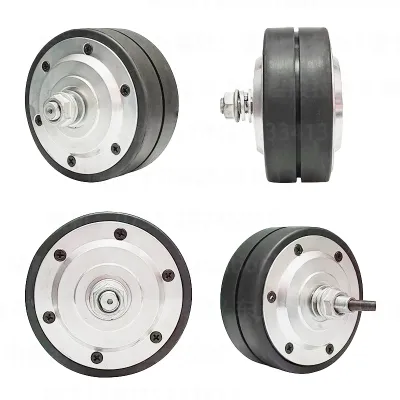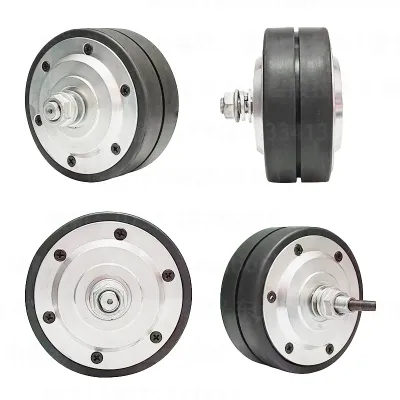
This technical brief analyzes the thermal management and mechanical design choices of a high-durability 4-inch brushless hub motor engineered for continuous, high-frequency use in sports ball machines. It examines a PU waterway cooling approach, a 42 mm dual-thread output shaft, and complementary structural optimizations that together secure stable output, reduced noise, and longer in-field life for export-level equipment.
High-frequency ball machines place sustained thermal stress on compact drive units. Continuous wheel spin, frequent acceleration/deceleration and compact packaging restrict passive heat rejection. Uncontrolled stator and bearing temperatures accelerate insulation aging, reduce torque margin and increase acoustic emission. For equipment aimed at international markets, thermal reliability can be the difference between warranty claims and repeat OEM partnerships.
The solution under review integrates a four-inch brushless hub motor where the rotor assembly directly drives the wheel/tire assembly and the stator houses a tightly integrated PU (polyurethane) waterway cooling circuit. This approach prioritizes direct thermal extraction from the stator and bearing regions while preserving a sealed, service-friendly envelope for export compliance and field reliability.
PU-based waterway channels are molded or overmolded into the stator housing or an internal sleeve. Coolant circulates through these channels and extracts heat from the stator core and winding end-turns via convective heat transfer. Compared with forced-air cooling in a sealed hub assembly, liquid cooling increases thermal conductance and reduces steady-state temperature rise for the same power loss.
The following example presents reference temperature-rise behavior during a continuous operational profile frequently encountered in high-end ball machines (rated mechanical load representative of launching at 50–75% of motor capacity). These numbers reflect an engineered PU waterway cooling implementation versus an air-only cooled baseline. They are reference figures for design guidance.
Figure: Reference temperature-rise curves. With PU waterway cooling, steady-state winding temperature rise after 60 minutes of continuous operation can be lowered by ~20–30°C compared with an air-only design for similar losses (example).
A compact mechanical layout enables direct heat transfer from the stator to the coolant channels and then to the external heat exchanger or chassis. The 42 mm dual-thread (double-start) output shaft is a deliberate mechanical choice: it increases axial stiffness, provides a larger contact area for mechanical couplers, and functions as a thermal bridge that helps draw heat away from internal assemblies.
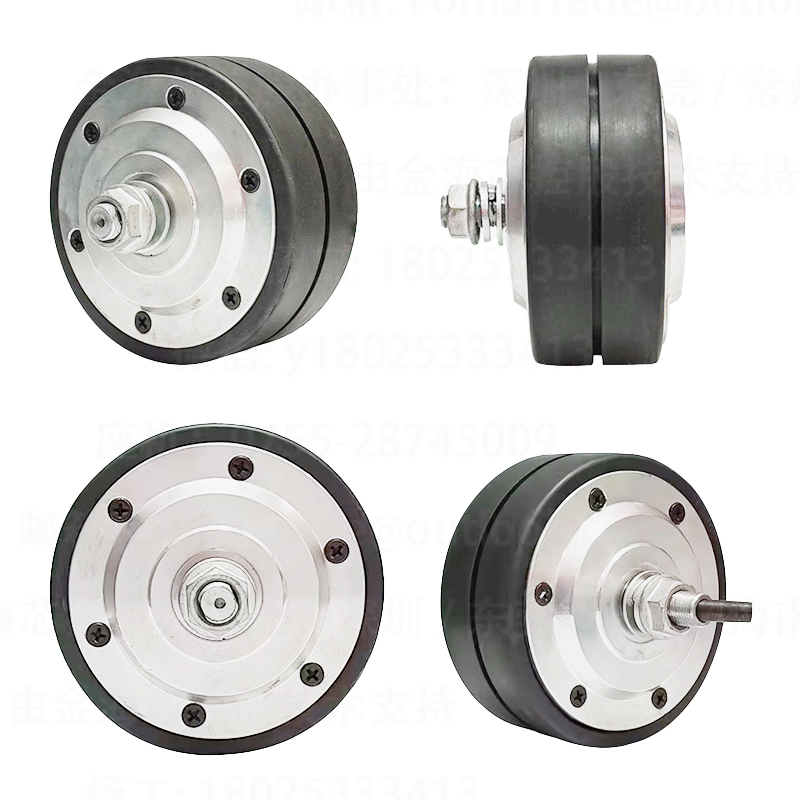
The visually-documented cross-section above highlights:
The dual-thread (double-start) 42 mm shaft produces several advantages:
Effective temperature control reduces bearing friction growth and prevents grease breakdown — two primary contributors to steady-state and broadband noise. Lower internal temperatures also reduce thermal expansion cycles that can loosen press-fits and fasteners, thereby decreasing the frequency of preventive maintenance tasks for OEMs and end-customers.
For manufacturers specifying hub motors for export-grade ball machines, a focused checklist reduces rework and accelerates time-to-market:
Motors and assemblies targeted at global markets should anticipate certification and labeling needs. Typical expectations include CE for EU markets, RoHS compliance for materials, and IEC-based testing for thermal and mechanical endurance. Test evidence of thermal cycling, ingress protection (IP55 or higher where washdown is expected), and bearing life (L10hr) will accelerate customer acceptance in Europe, North America and Asia-Pacific marketplaces.
With proper thermal design, realistic lifecycle targets for a 4-inch hub motor in a commercial ball machine are achievable:
Have engineers encountered high-frequency torque fade or unexpected noise in their ball machines? Share a short description of the duty cycle and failure mode — the engineering team can advise targeted mitigations (channel sizing, shaft coupling changes or coolant flow rate adjustments).
A few integration-focused tips that reduce launch risk:
The following reference values can be used in preliminary thermal-budget calculations. They assume a conservative motor loss of 65–120 W under continuous competitive profiles (this range should be updated with measured loss data during prototype testing):
These figures are sample targets; measured performance depends on channel geometry, coolant inlet temperature, flow rate and motor losses.
OEMs and R&D teams evaluating hub motor options can accelerate validation by requesting representative thermal maps and bearing life predictions. Share a short profile (target balls per minute, system ambient, duty cycle) and get tailored feedback on whether a PU waterway approach with a 42 mm dual-thread shaft suits the application.
Includes recommended PU waterway layouts, shaft interface CAD and endurance guidance — ideal for design freeze and supplier selection.
Interested readers are invited to submit brief application notes or typical duty profiles for a focused review. Case studies of environment-driven adaptations (e.g., coastal, high-altitude, high-humidity) are welcome for peer comparison.

 316
|
316
|
 brushless hub motor
lawn mower drive motor
short-shaft hub motor
low-noise mower motor
326
|
brushless hub motor
mower drive motor
10-inch brushless hub motor
low-noise brushless motor
anti-tangle mower motor
brushless hub motor
lawn mower drive motor
short-shaft hub motor
low-noise mower motor
326
|
brushless hub motor
mower drive motor
10-inch brushless hub motor
low-noise brushless motor
anti-tangle mower motor